Every mining operation relies on its fleet to hit production targets. However, simply owning high-capacity trucks and excavators does not guarantee profitability. The real challenge lies in how effectively you are using those assets during a shift. When equipment sits idle in a queue or waits for a shift change, you spend capital without moving material.
This article examines the strategies fleet managers can employ to bridge the gap between potential and actual performance. We will discuss how to improve equipment utilization in mining, measure effective utilization rates, calculate the actual cost of each haul cycle and implement data-driven changes that reduce downtime.
Understanding Mining Equipment Utilization Rates
To optimize a fleet, you must first distinguish between two easily confused metrics:
- Mechanical availability: Mechanical availability quantifies the percentage of time a machine is physically capable of operation, regardless of whether it is currently in use.
- Effective utilization: By contrast, effective utilization measures the actual productive hours the asset spends moving material or generating revenue.
In many operations, a disconnect exists between these two figures. A haul truck might boast 90% mechanical availability, meaning it is ready to work for the vast majority of a shift. Yet, its effective utilization might hover around 60%. The remaining 30% vanishes into operational voids, such as:
- Slow dispatching that leaves a shovel waiting for a truck
- Sitting in queue lines waiting for the shovel
- Idling during extended operator breaks
- Minutes lost during a shift change
These seemingly insignificant downtimes may not appear on a repair log, but they erode return on investment (ROI) just as quickly as a breakdown. As a result, fleet managers ought to shift their focus from purely maintenance-based KPIs to operational indicators.
How to Calculate Cost Per Cycle in Mining
While cost-per-ton is a standard industry metric, it often aggregates too much data to be actionable for daily fleet management. To diagnose specific efficiency issues, you need to calculate the cost per mining cycle using the formula:
- Cost per cycle = Total operating cost ÷ total haul cycles
The accuracy of this calculation depends on the quality of your inputs. It is essential to account for all operational cost variables, including:
- Fuel burn during idle time, which offers zero return on investment
- Tire wear, which accelerates significantly on poorly maintained haul roads
- Support services such as road maintenance
- Operator wages
- Lubricants
Impact on ROI
Improving utilization density is one of the fastest ways to lower the cost per cycle. For instance, if you can increase the number of cycles completed in a shift from 20 to 22 without increasing the shift length, you spread your fixed costs over more revenue-generating units. This increased efficiency instantly lowers your cost per cycle and improves the asset’s ROI without the need to purchase new equipment or hire additional staff.
Identifying Underutilized vs. Overutilized Assets
Data visibility enables you to identify assets that are underperforming or overperforming. Both extremes pose a threat to your capital efficiency.
Underutilized Assets
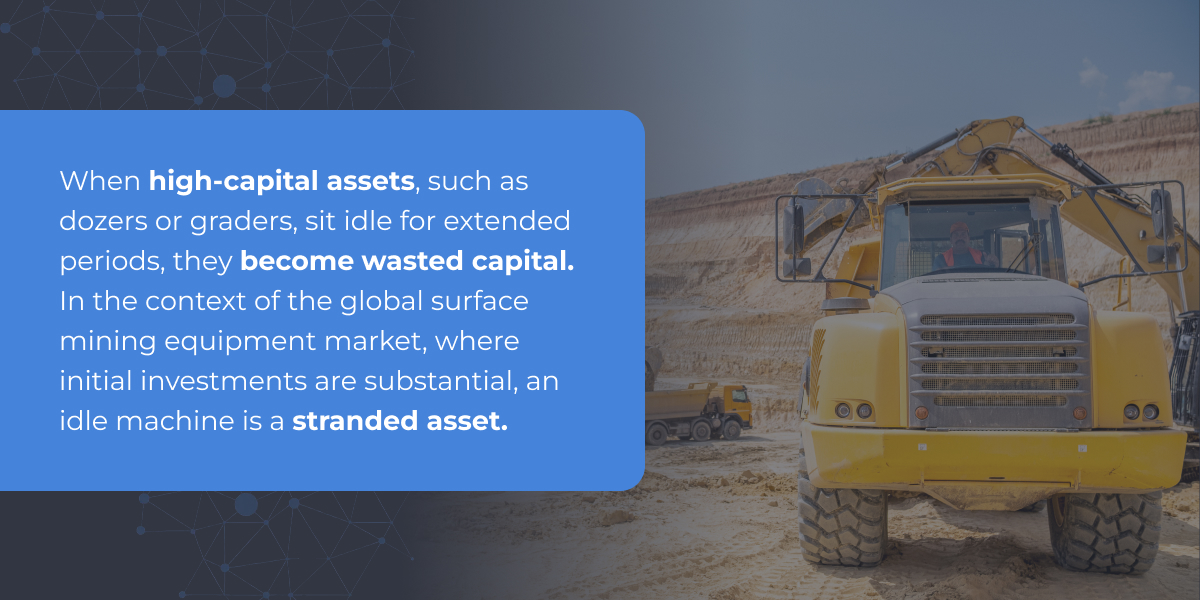
When high-capital assets, such as dozers or graders, sit idle for extended periods, they become wasted capital. In the context of the global surface mining equipment market, where initial investments are substantial, an idle machine is a stranded asset. However, data is required to understand why it is idle. For example, if haul trucks are consistently waiting at the crusher, the trucks may appear underutilized despite being fully staffed. In such a case, the root cause of inefficiency is a process failure, not a lack of demand.
Overutilized Assets
Conversely, pushing equipment consistently beyond its rated capacity or duty cycle invites catastrophic failure. Overutilization is subtler compared to underutilization. It can manifest in various ways, such as:
- Excavators being run at redline temperatures for 90% of a shift.
- Engines running at peak RPMs for extended periods.
- Trucks consistently carrying payloads 20% above their rating.
While equipment overutilization may boost short-term production numbers, it accelerates depreciation and increases the likelihood of unplanned downtime in the long run.
Reallocation Strategy
Some strategies you can employ to avoid underutilization or overutilization include:
- Dynamic deployment: Move underutilized support equipment to high-demand zones based on real-time heat maps.
- Balance workloads: Rotate assets between high-stress and low-stress haul routes to even out wear and tear.
Matching Equipment to Tasks Based on Performance Data
One of the most effective ways to improve utilization is to ensure the right machine is on the right job. A mismatch between equipment capabilities and task requirements creates inherent inefficiencies that no amount of operator training can fix.
Right-Sizing the Load
Efficiency drops significantly when the pass match between loading and hauling units is off. If an excavator requires five passes to fill a truck designed for three, the extra passes add unnecessary idle time to every cycle. Over a 12-hour shift, even a few minutes can add up to lost loads. Matching the fleet minimizes load times and ensures that trucks spend more time on the haul road, thereby increasing efficiency.
Route Optimization
Telematics data can reveal which vehicles perform best on specific profiles. For instance, rigid frame trucks may offer better speed and fuel efficiency on long, flat haul roads, while articulated trucks may be more suitable for steeper, rougher terrain. Performance data enables managers to assign specific vehicles to the route profiles for which they are best suited.
Operator Capability
By analyzing cycle times and fuel burn rates by operator, managers can identify the skill gaps they need to address. This insight allows for strategic rostering, where the most skilled operators are paired with the most critical machinery or the most challenging terrain, ensuring that complex tasks are handled with maximum efficiency.
Reducing Downtime and Extending Lifespan Through Predictive Maintenance
Mining equipment downtime reduction requires a shift from reactive to proactive maintenance strategies.
Calendar-Based to Usage-Based Servicing
Traditional maintenance schedules service a vehicle after a predetermined amount of time, regardless of workload. This type of maintenance model may lead to two adverse outcomes:
- Overservicing equipment that hasn’t worked hard, thus wasting parts and labor.
- Underservicing vehicles that have been pushed to their limits, thus risking failure.
Usage-based maintenance uses real-time data, including engine load and total operational hours, to determine service intervals. Some benefits of transitioning to a proactive maintenance strategy include:
- Early warning signals: Modern sensors detect anomalies that a human inspection might miss, such as slight vibrations in a bearing or marginal increases in hydraulic temperatures. These signals allow maintenance teams to intervene before a catastrophic failure occurs.
- Improved downtime strategy: By addressing a worn part during a planned production stop rather than waiting for it to snap mid-haul, mines can reclaim hundreds of hours of production capacity annually.
- Better life cycle planning: When a component fails, managers must decide whether to repair, rebuild or replace it. Historical load data helps determine if the rest of the machine has enough residual life to justify a costly rebuild.
- Higher resale value: A machine with a documented, data-backed history of optimized usage and proactive maintenance commands a higher resale value.
- Increased long-term ROI: Extending the lifespan of existing assets through improved load management and maintenance helps reduce the frequency of significant capital expenditures, freeing up cash flow for other operational enhancements or technological investments.
Achieve Total Fleet Visibility With Intermountain Technologies
Optimization requires a cultural shift from simply keeping equipment running to ensuring it remains productive. However, you cannot optimize what you do not measure. Intermountain Technologies bridges this gap through AVA Data-Driven Mine Management Solutions.
AVA is a cloud-based fleet management system that acts as the central nervous system for your operations, specifically designed to visualize utilization data without the need for massive hardware investments. It provides the granular insight needed to track real-time cycle times, pinpoint dispatch bottlenecks and monitor asset health from a single, intuitive dashboard. With AVA, fleet managers can move beyond simple availability logs and achieve precise equipment utilization.
Contact Intermountain Technologies today to request a fleet assessment or demo and learn how you can transform raw fleet data into actionable ROI strategies.